World of Cereal Mascots: From Iconic Characters to Cherished Canadian Childhood Memories
June 22, 2026 Explore Blogs
There’s a particular kind of morning memory that belongs to Canadian childhoods. A bowl of cereal on a Saturday morning, cartoons flickering on the television, and a familiar face on the box staring back across the kitchen table. A striped tiger. A mischievous rabbit. A leprechaun guarding his charms.
For millions of Canadians from Vancouver to Halifax, cereal mascots are woven into the fabric of growing up. These characters are not simply printed graphics on cardboard packaging, they are cultural reference points, emotional anchors, and some of the most enduring examples of brand identity ever created in the consumer goods world.
In this guide, we explore the full story of cereal mascots: their origins, their psychology, their most iconic figures, and what they continue to teach us about the power of character-driven packaging design with a particular lens on how Canadians have experienced and related to these beloved breakfast companions
What Are Cereal Mascots and Why Do They Resonate So Deeply?
A cereal mascot is a branded character anthropomorphic, fictional, or loosely modelled on a real creature created by a breakfast cereal manufacturer to represent a product and build emotional connection with consumers, particularly children and families.
In Canada, where English and French bilingual households have long been a defining feature of the consumer landscape, cereal packaging has historically served a dual cultural function. Boxes destined for Canadian shelves have been required under the Canadian Consumer Packaging and Labelling Act to carry bilingual text in English and French meaning that Canadian children encounter cereal mascots not just as visual characters but as figures embedded in a bilingual world. Tony the Tiger has told Canadian kids “Ils sont Super!” just as readily as “They’re Gr-r-reat!”
Beyond language, cereal mascots work through deep psychological mechanisms that transcend geography. Consumer psychology research identifies parasocial relationships the one-sided emotional bonds people form with fictional characters as one of the primary mechanisms behind mascot effectiveness. When a Canadian child cheers for the Trix Rabbit, they are emotionally invested. That investment creates brand loyalty, purchase influence, and the kind of memory that persists for decades.
The Canadian Cereal Landscape: A Market With Its Own Character
Canada’s grocery retail landscape has always had a distinct flavour. Major national chains including Loblaws, Sobeys, Metro, and Save-On-Foods have shaped how cereal brands reach Canadian consumers, and regional preferences have historically influenced which products and which mascots received the most prominent shelf placement and promotional investment.
Canadian consumers have had strong and sustained relationships with the major cereal manufacturers Kellogg’s, General Mills, and Post all of whom have operated Canadian facilities or maintained dedicated Canadian marketing operations. Kellogg’s, notably, operated a production facility in London, Ontario for decades, a plant that was a point of genuine regional pride and a tangible connection between Canadian workers and the cereal brands Canadians knew and loved.
For many Canadians, the mascots on their cereal boxes weren’t simply American exports. They were familiar presences in a specifically Canadian morning ritual appearing in Canadian-produced television commercials, on boxes sold at corner stores and IGA, and as costume characters at Canadian fall fairs and community events.
The Origins and Evolution of Cereal Mascots
The Early Era (1900s–1940s)
The history of cereal mascots begins well before Saturday morning cartoons or colour television. The Quaker Man, the robed figure on Quaker Oats packaging, is the oldest registered trademark mascot in North American history, first appearing in 1877. He established the foundational template: a consistent, trusted character whose face becomes inseparable from the product.
By the 1930s and 1940s, brands like Kellogg’s were using illustrated characters in print advertising distributed across Canada and the United States. Snap, Crackle & Pop the trio of elf-like figures representing the sounds of Rice Krispies emerged in this era, making them among the earliest mascot characters that Canadian children would have encountered.
Radio advertising brought these characters to life with voices and personalities before television existed, building early parasocial familiarity with characters that would later become visual icons.
The Television Revolution (1950s–1970s)
Commercial television transformed cereal marketing on both sides of the border. In Canada, the Canadian Broadcasting Corporation (CBC) and early private broadcasters like CTV carried American and Canadian programming that included the Saturday morning cereal commercial blocks that defined a generation.
Tony the Tiger debuted in 1952 as the face of Kellogg’s Frosted Flakes Corn Flakes au Sucre in French Canada and quickly became the most recognized cereal mascot character in North America. His phrase “They’re Gr-r-reat!” became as familiar to children in Toronto and Winnipeg as it was in Chicago or New York.
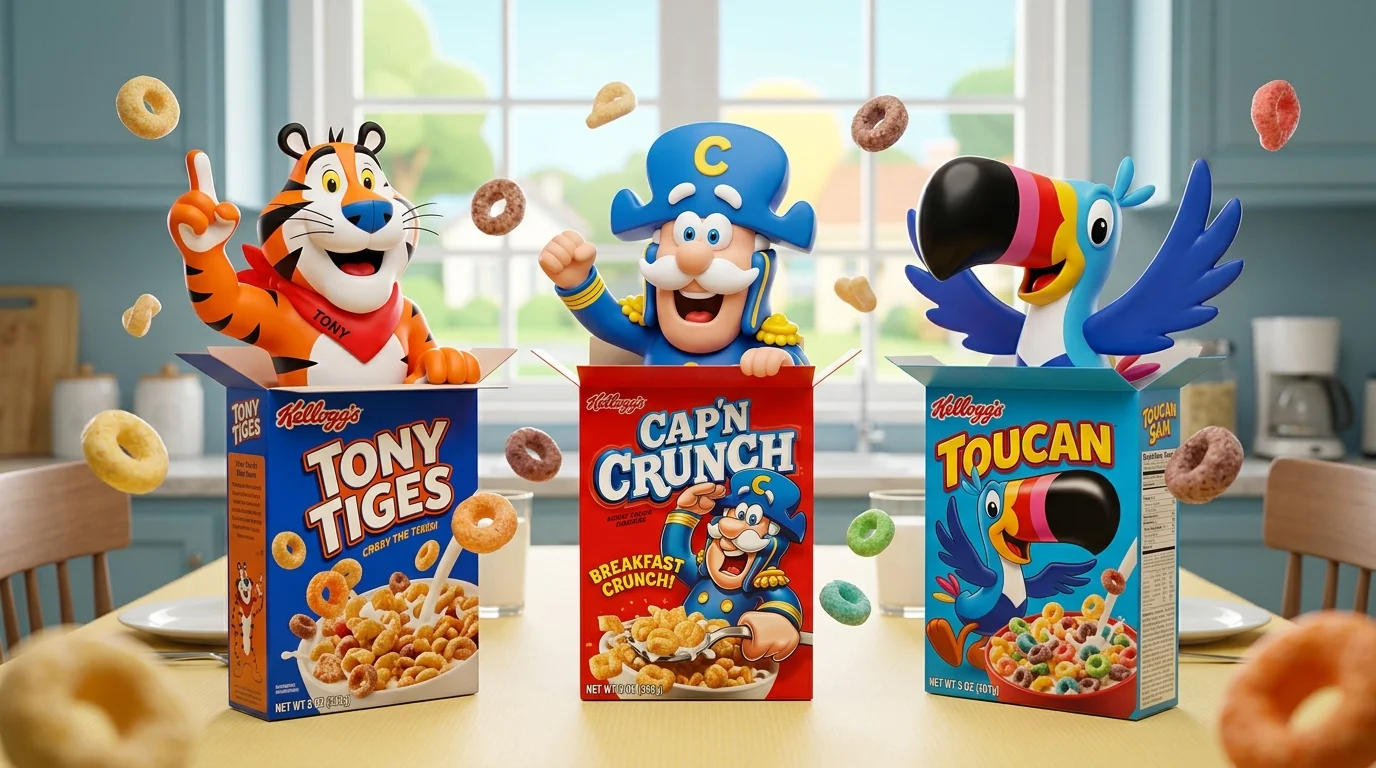
The same decade brought Toucan Sam (Froot Loops, 1963), Cap’n Crunch (1963), and Lucky the Leprechaun (Lucky Charms, 1964) into Canadian homes. Each character was deliberately distinct from different species, different personality archetypes, and different narrative hooks designed to occupy a unique emotional space in children’s minds.
The Golden Era: Canadian Kids and 1980s–1990s Cereal Mascots
The 1980s and 1990s were the undisputed golden age of cereal mascot culture in Canada, as they were across the English-speaking world. Saturday morning television was appointment viewing. Brands invested deeply in animated mascot content, in-box prizes, and collectible packaging.
For Canadians who grew up in this era, 90s cereal mascots are among the most potent triggers of breakfast nostalgia. Characters like Sonny the Cuckoo Bird (Cocoa Puffs), the Trix Rabbit, and Count Chocula weren’t just advertising figures, they were recurring characters who showed up every Saturday morning, reliably, without fail.
Canadian children of this era remember another distinctive feature of the 90s cereal experience: in-box prizes and collectible packaging. Limited-edition boxes with holographic designs, toys, or games inside were events in themselves. Choosing which cereal to buy and lobbying parents accordingly at the Loblaws or Safeway checkout was driven as much by the box as by the contents.
The Most Iconic Cereal Mascots A Canadian Perspective
Tony the Tiger Frosted Flakes (Kellogg’s)
No cereal mascot has achieved the cultural permanence of Tony. Created in 1952, he has appeared on Canadian breakfast tables continuously for over 70 years. His visual identity an upright, confident tiger in a red neckerchief communicates energy, achievement, and enthusiasm. His sports-linked advertising campaigns have resonated particularly well in Canada, a country with a deep sporting culture around hockey, curling, and track and field. Tony has appeared in Canadian marketing tied to hockey leagues and amateur athletics, making him feel genuinely connected to Canadian values rather than simply imported from American advertising.
For French Canadian audiences, Tony’s bilingual presence — “Ils sont Super!” — gave the character an additional layer of local relevance that many other mascots lacked.
The Trix Rabbit Trix (General Mills)
Introduced in 1959, the Trix Rabbit is built on one of advertising’s most elegant narrative structures: a character perpetually denied the thing he wants most. Canadian children have grown up cheering for, laughing at, and empathizing with this determined rabbit across generations. The character is a masterclass in narrative-based brand identity; you don’t just remember the character, you remember the story.
Toucan Sam Froot Loops (Kellogg’s)
Toucan Sam’s rainbow-striped beak is one of the most effective examples of synesthetic packaging design, a visual character that communicates taste and smell without words. His adventure-seeking personality and the “follow your nose” narrative have made him a consistent favourite across Canadian age groups since his 1963 debut.
Froot Loops has historically been one of the strongest-selling children’s cereals in Canada, and Toucan Sam’s design vibrant, immediately recognizable, and culturally neutral has translated effectively across both English and French Canadian markets.
Snap, Crackle & Pop — Rice Krispies (Kellogg’s)
This trio holds a special place in Canadian cereal history as one of the earliest mascot characters to reach Canadian audiences, dating to the 1930s. Their identity is built not on personality or adventure but on sensory experience — the sounds of the cereal itself, personified. The three small elf-like figures represent one of the earliest and most enduring examples of multi-character mascot marketing in any consumer category.
Rice Krispies squares — the beloved Canadian treat made from the cereal — have only deepened the cultural connection between Snap, Crackle & Pop and Canadian household identity.
Cap’n Crunch — Cap’n Crunch (Quaker Oats)
Launched in 1963, Cap’n Crunch’s nautical identity and adventure-framing gave him a particular resonance in a country with vast coastlines, a deep maritime heritage in Atlantic Canada, and strong traditions of seafaring history. His world-building approach — an implied universe of ships, seas, and discovery — positioned breakfast cereal as the starting point of an adventure, and Canadian children responded to that framing enthusiastically.
Lucky the Leprechaun — Lucky Charms (General Mills)
Introduced in 1964, Lucky has become the definitive St. Patrick’s Day advertising figure in North America — including in Canadian cities with large Irish-heritage communities like Montreal, Toronto, and Halifax. His association with magical marshmallow shapes created a product mythology inseparable from the character himself. Lucky Charms has developed a particularly strong following in Canada, where the cereal’s limited availability in earlier decades made it feel like a special treat rather than a daily staple.
Count Chocula — Count Chocula (General Mills)
Count Chocula is one of the most effective examples of seasonal mascot marketing ever created. As a chocolate-loving vampire who becomes the face of Halloween breakfast culture every October, he returns to Canadian shelves annually with the reliability of changing leaves and back-to-school shopping. In Canada, where Halloween is a deeply celebrated cultural event with strong community traditions, Count Chocula’s seasonal resonance is particularly strong.
BuzzBee — Honey Nut Cheerios (General Mills)
BuzzBee is the cheerful honeybee face of Honey Nut Cheerios — consistently one of the best-selling cereals in Canada. What makes BuzzBee particularly interesting in the Canadian context is his evolution beyond pure brand mascot into a figure associated with pollinator conservation messaging. Given Canada’s strong environmental consciousness and the significance of agricultural pollination to Canadian farming, BuzzBee’s dual role as cereal character and conservation symbol has landed with unusual authenticity in this market.
Lesser-Known Cereal Mascots Worth Knowing
Beyond the household names, Canadian breakfast culture has been enriched by a supporting cast of mascot characters that deserve recognition.
Sonny the Cuckoo Bird (Cocoa Puffs, General Mills) — The manic, perpetually cocoa-obsessed bird whose “I’m cuckoo for Cocoa Puffs!” tagline became a fixture of Canadian childhood vocabulary. His energy-driven personality archetype was deliberately designed to mirror the enthusiasm of children themselves.
Sugar Bear (Golden Crisp, Post) — An effortlessly cool bear who approaches his cereal with laid-back confidence rather than manic enthusiasm. Sugar Bear represents a rarer personality model in cereal branding — the mascot as aspirational cool rather than hyperactive excitement.
Dig’em Frog (Honey Smacks, Kellogg’s) — A spunky, streetwise frog with surprising longevity, going through multiple visual redesigns over decades while maintaining core personality traits. A strong example of mascot evolution in response to changing cultural aesthetics.
CinnaMon and Bad Apple (Apple Jacks) — A mascot pair built on flavor rivalry, representing the cinnamon and apple profiles of the cereal. One of the earlier examples of adversarial character pairs used to dramatize product flavor contrast.
Cornelius “Corny” Rooster (Corn Flakes, Kellogg’s) — One of the most quietly enduring figures in cereal history. A natural-world animal whose early-rising associations align perfectly with the breakfast occasion — and a character with particular relevance given Kellogg’s long manufacturing history in London, Ontario.
Female Cereal Mascots: The Representation Gap
A candid examination of cereal mascot history reveals a striking imbalance: the overwhelming majority of iconic cereal mascots are male-coded characters. Tony, Cap’n Crunch, Lucky, Sonny, the Trix Rabbit, BuzzBee, Dig’em Frog — the list of prominent male mascots is long. Recognizable female mascot figures are rare.
Pebbles Flintstone, appearing on Fruity and Cocoa Pebbles (Post), is one of the few well-known female characters in the category. In some versions of Kellogg’s Rice Krispies advertising, Crackle from the Snap, Crackle & Pop trio has been depicted with female characteristics, though this has never been the dominant representation.
In Canada — where conversations about gender representation in media and advertising have been part of mainstream cultural discourse since the 1980s and where regulatory bodies have shown increasing attention to diversity in children’s advertising — the female representation gap in cereal mascots is both a cultural observation and a missed brand opportunity.
Research in children’s advertising consistently demonstrates that diverse character rosters broaden emotional reach across family purchase decision-makers. Canadian families with daughters represent a substantial portion of cereal purchase decisions. Brands that introduce well-designed, personality-rich female mascot characters have a genuine opportunity to deepen household resonance in a market that is both large and underserved by existing character options.
The Psychology Behind Why Cereal Mascots Work
Understanding the enduring power of cereal mascots requires a brief look at the psychological mechanisms that make them so effective mechanisms that operate consistently across cultures, including the Canadian market.
Anthropomorphism is the foundational mechanism. The human brain is neurologically predisposed to perceive faces, emotions, and social intentions in non-human entities. A tiger who smiles or a rabbit who schemes engages the same social cognition systems we use for real human relationships, making mascot characters immediately and intuitively legible to young children.
Narrative engagement deepens anthropomorphism into genuine emotional investment. The best cereal mascots exist within ongoing stories the Trix Rabbit who never gets his cereal, Lucky who must protect his charms, Cap’n Crunch on his perpetual voyage. These narrative loops sustain engagement across hundreds of advertising exposures over years.
Parasocial bonding is the cumulative result. Repeated exposure to a mascot character creates a felt sense of genuine familiarity and relationship. The child who watches Tony the Tiger commercials every Saturday develops a form of affection that feels real and that affection transfers directly to the product and brand.
Distinctive asset design ensures that visual elements alone color, shape, silhouette trigger brand recognition without requiring a name or logo. Tony’s orange-and-black stripes, Toucan Sam’s rainbow beak, Lucky’s green coat and hat — these are distinctive assets in the technical brand design sense: visual properties so strongly associated with a single brand that they function as identifiers in their own right.
Cereal Mascots in the Modern Canadian Market
The media environment that shaped cereal mascot culture in Canada has changed dramatically. The Saturday morning cartoon block — the primary vehicle for cereal advertising for three decades — is largely a memory. Canadian children today consume content through Netflix, YouTube, TikTok, Roblox, and gaming platforms.
Canadian cereal brands and their parent companies have adapted mascot strategies accordingly. Tony the Tiger maintains an active social media presence. BuzzBee appears in digital content tied to environmental campaigns. Several brands have introduced limited-edition mascot packaging tied to Canadian cultural moments, seasonal events, and sports properties — continuing the collectible box tradition of the 1990s in a digitally amplified format.
Custom printed cereal boxes have become an increasingly powerful tool in this landscape. As digital printing technology has reduced the cost and lead time for short-run specialty packaging, brands can produce limited-edition mascot designs, bilingual seasonal artwork, and regionally targeted packaging that creates genuine collector appeal — at a fraction of the cost and timeline that equivalent work required a decade ago.
For Canadian brands in the food and consumer goods space, character-driven custom packaging represents one of the highest-ROI touchpoints available: a physical object that sits on a kitchen table for days or weeks, delivering repeated brand exposure in one of the most emotionally significant domestic spaces — the family breakfast table.
A Reference Guide to Cereal Mascots on Canadian Shelves
| Mascot | Brand | Manufacturer | Core Personality | Canadian Cultural Connection |
| Tony the Tiger | Frosted Flakes | Kellogg’s | Athletic, encouraging | Hockey & sports marketing tie-ins; bilingual campaigns |
| The Trix Rabbit | Trix | General Mills | Determined, narrative-driven | Pan-Canadian childhood nostalgia |
| Toucan Sam | Froot Loops | Kellogg’s | Adventurous, sensory | Consistently top-selling children’s cereal in Canada |
| Snap, Crackle & Pop | Rice Krispies | Kellogg’s | Sound-themed trio | Rice Krispies squares as Canadian cultural staple |
| Cap’n Crunch | Cap’n Crunch | Quaker Oats | Nautical, world-builder | Maritime heritage resonance |
| Lucky the Leprechaun | Lucky Charms | General Mills | Clever, magical | Irish-heritage community connection; St. Patrick’s Day |
| Count Chocula | Count Chocula | General Mills | Halloween icon | Strong Canadian Halloween cultural resonance |
| BuzzBee | Honey Nut Cheerios | General Mills | Eco-conscious, friendly | Canadian environmental values alignment |
| Sonny the Cuckoo Bird | Cocoa Puffs | General Mills | Manic, cocoa-obsessed | 90s Saturday morning nostalgia |
| Sugar Bear | Golden Crisp | Post | Cool, laid-back | Distinct personality archetype in Canadian market |
| Cornelius Rooster | Corn Flakes | Kellogg’s | Reliable, early-rising | Kellogg’s London Ontario manufacturing heritage |
Why Cereal Mascots Are a Masterclass in Brand Building
For anyone working in marketing, packaging design, or brand strategy in Canada, cereal mascots offer some of the most instructive long-term lessons in the entire consumer goods industry.
The best cereal mascots are visually distinctive at every scale recognizable on a small box thumbnail in an online grocery listing just as readily as on a full-height store display. That level of visual robustness is extraordinarily rare in brand design.
They are personality-consistent across decades. Tony has never been defeated. The Trix Rabbit has never given up. Lucky has never lost his magic. This consistency compounds in brand equity value over time in ways that no single campaign can replicate.
They are emotionally calibrated to developmental psychology. The most effective cereal mascots are designed with an implicit understanding of how children aged 4–12 process narrative, character, and aspiration. They are not simply appealing characters they are characters engineered to resonate at a specific developmental stage.
And critically, they translate across every media format. The greatest cereal mascots work on packaging, in television commercials, in digital content, on merchandise, and in costume at live events. This media agnosticism is the hallmark of truly great character design and a standard every brand building a mascot or character identity should aspire to.
Final Thoughts: A Character at the Canadian Breakfast Table
From the Quaker Man’s first appearance in 1877 to BuzzBee’s environmental messaging in the 2020s, cereal mascots have demonstrated a remarkable capacity to endure across generations, media formats, and cultural shifts. In Canada with its bilingual packaging requirements, its regionally diverse consumer culture, and its deep traditions of community and family breakfast ritual these characters have found particularly fertile ground.
The Canadian child who poured cereal and read the back of a box in 1987 is today a parent choosing breakfast cereals for their own children. The emotional associations formed at age seven don’t disappear they transfer, influence purchase decisions, and create the kind of multi-generational brand loyalty that no advertising budget can simply manufacture.
That is the deepest truth about cereal mascots, in Canada as everywhere: they are not just characters on a box. They are memory anchors, carefully designed to attach themselves to the warmest, most unguarded moments of human experience early mornings, the smell of a bowl of cereal, the unhurried pleasure of a Saturday with nowhere to be.
In a media landscape of infinite fragmentation and disappearing attention spans, a character who has shown up reliably at the Canadian breakfast table for 70 years is not just a marketing asset. It is a genuine piece of cultural heritage.